

Twenty years later, Doru returned.

Not out of longing—he no longer believed in longing. He believed in things that could be verified: documents, blood test results, invoices. After the Revolution, he had moved to Germany, worked for an accounting firm, married, divorced, and learned not to cry when listening to songs.

He came back for his mother’s funeral. And, as often happens in small towns, the funeral coincided with something else: a commemoration.

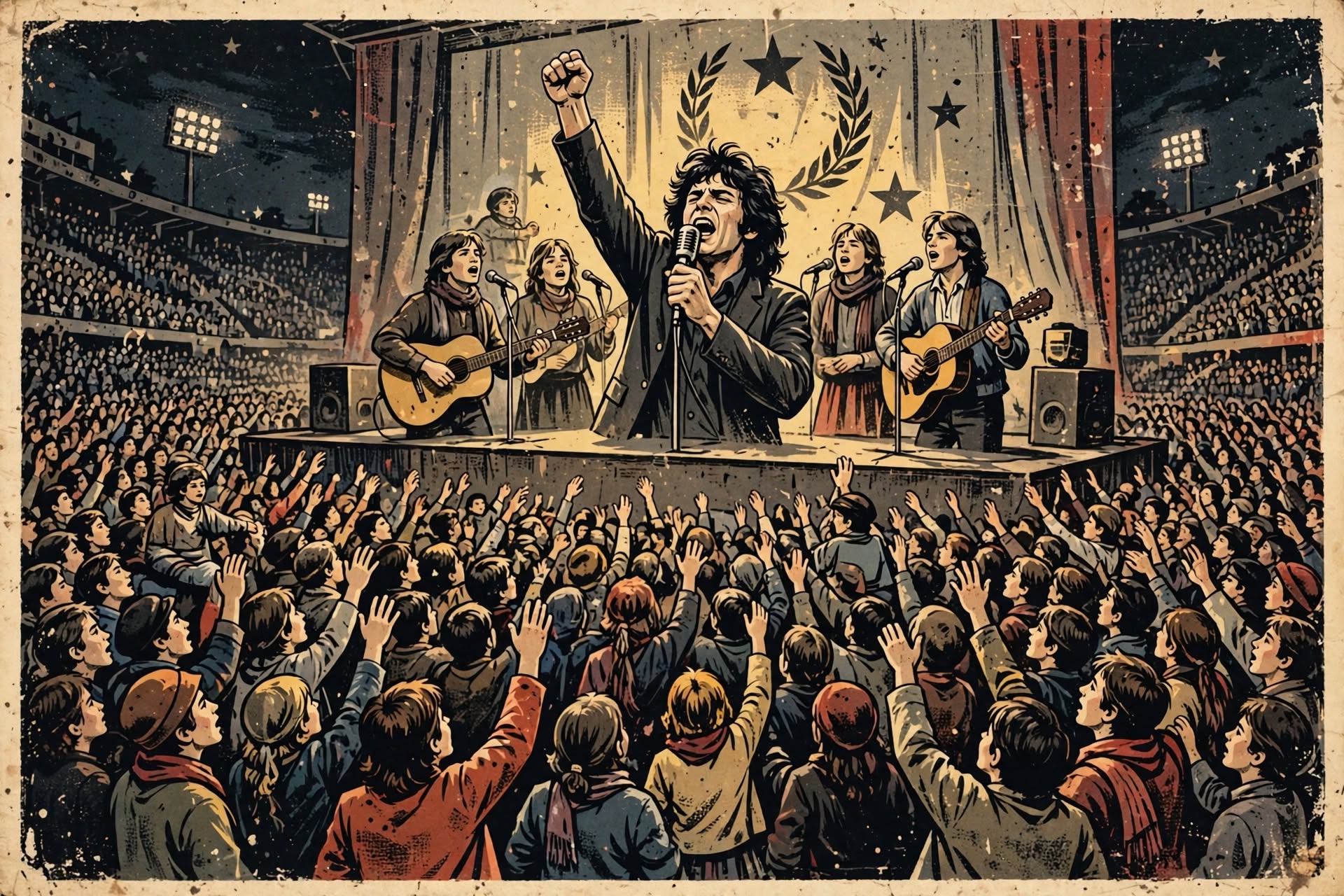
At the old stadium—where, back in ’83, we had danced in a trance—a concert was being held: "Cenaclul Flacăra — 30 Years. An Evening of the Romanian Soul." The poster was new, computer-designed, with clean, crisp fonts. It no longer proclaimed THE PEOPLE, FREEDOM, or THE TRICOLOR. Instead, it read: IDENTITY, TRADITION, THE NATION.

Doru called me. His voice was the same, though perhaps a bit more tired.

"Will you come with me? I want to see if I still remember the lyrics."

I laughed. We both laughed—the kind of laughter people use to keep fear at bay.

We went.

The stadium wasn't packed the way it used to be; it was full in a different way. There were no longer thousands of kids brought in by the busload. Instead, there were people our own age—men with bellies, carrying mobile phones, holding their own children by the hand. Some wore T-shirts emblazoned with the Poet’s face. Others wore traditional *ii* (peasant blouses), while some were dressed in suits. There were even young people with guitars. There were local politicians, too, wearing their campaign smiles, posing for photos near the stage.

The Great Poet was no longer on stage. He had died. In his place stood a massive screen. On the screen, he was reciting—the same thundering voice, the same mane of hair, the same prophetic gaze of a man who knows he’s right before he even opens his mouth.

Then the singers appeared. Some were the old guard—older now, heavier. Others were new, young, with clear, pure voices, singing the old lyrics as if they’d been written just yesterday.

At first, Doru stood with his hands in his pockets. Cold. Analytical. German.

"See?" he said to me. "It’s kitsch. It’s nostalgia. People came to remember their youth, not the Party. It’s over."

I nodded. I wanted to believe him.

But then, the music began.

And I felt it all over again. Not in my ears—in my gut. In my very bones.

The rhythm had changed; those military-style drums were gone. It was softer, more modern—an acoustic guitar, a cello, and a percussion beat that sounded like a heartbeat. Yet, the swaying motion remained the same.

Slowly, the crowd began to sway. Left—right. Left—right. Like reeds in the wind.

A little girl, maybe eight years old, perched on her father’s shoulders, was singing the lyrics in a state of pure ecstasy. She didn’t know what the words meant—but she knew them by heart.

Doru looked at her and froze.

"Doru?" He didn’t answer me. He was looking at the stage. At the screen. At the little girl. At his own hands, which had slipped out of his pockets without him noticing and were now tapping out a rhythm against his thighs. Lightly. Automatically. Like a reflex.

That was when I understood what I hadn’t grasped back in ’83.

The mechanism hadn’t died along with the regime. The mechanism was older than the regime. The regime had merely rented it for a while. It had dressed it in a red uniform. Now, the uniform was different. It was white. It was clean. It was a designer brand. Emblazoned on it were words like IDENTITY, TRADITION, and ROMANIAN SOUL.

But underneath, it was the same old thing: you were granted permission to feel, so that you would no longer need to think.

It was no longer about the Party. Now, it was about the Nation. About Ancestors. About Heroes. About the idea that we are special, that we have suffered more, that we know better. It was the same pharmaceutical dose, carefully administered: a little bit of freedom, a little bit of pride, a little bit of anger toward "the others"—just enough to make you feel alive, just enough to keep you from asking who was dropping the pill into your glass.

On stage, a young man with a magnificent voice began to sing about Freedom. And the crowd shouted, "FREEDOM!" Doru shouted, too.

Not loudly. In a whisper. But he shouted.

And then he stopped, startled by the sound of his own voice—like someone waking up to find themselves talking in their sleep, in a language they thought they had forgotten. He took my hand. His hand was sweating.

“Do you remember what you asked me back then?” he said. “Why I cried? I don’t even like those poems.”

I nodded.

“Now I know why. Because it wasn’t me crying. It was the longing inside me—the longing they planted in my head when I was seventeen. And that kind of longing never dies. It just changes its clothes.”

We stayed until the end. Not because we enjoyed it, but because we couldn’t leave. It’s hard to walk away from a place where three thousand people are singing in unison. You feel like a traitor if you stay silent; you feel like a madman if you speak.

Outside, on the sidewalk, Doru stopped and looked back at the illuminated stadium.

“You know what the most twisted part is?” he said. “Back in ’83, at least we knew someone was lying to us. It was clear—it was the Party. Now, no one even knows who’s doing the lying. Now, everyone believes they chose the song themselves—that it’s their own free choice, that it comes from their own soul.”

“And doesn’t it?” I asked.

Doru smiled—a weary smile, the kind worn by a man who spent thirty years in accounting and knows that any balance sheet can be faked.

“It is our soul. But the arrangement—that belongs to someone else. It always has.”

That night, back at the hotel, Doru couldn’t sleep. In the morning, he told me he had dreamt of the stadium. That he had dreamed of thousands of people dancing in a trance. That in the midst, at the center of it all was the eight-year-old girl. And the girl was looking at him, saying, "Come on, mister, sing something too. Everyone else is singing. Why aren't you singing?"

And in his dream, he didn't know how to answer. Because one part of him wanted—with all his heart—to sing.

But the other part—the part that had learned to think—knew that if he started to sing, he would never be able to stop.

That, in the end, is the true horror. It’s not the monster on the stage. The monster is the longing within you—waiting patiently for twenty years, thirty years, an entire lifetime—for a signal to be given once again.

And when that signal comes, it begins to sing all on its own.
Discover more from Nösnerland
Subscribe to get the latest posts sent to your email.